
How SUTL Group of Companies Streamlined Purchase Order Processing with AI-Powered PO-to-SO Automation
In most B2B organisations, you will not be a stranger to purchase orders and sales orders. A purchase order is a buyer’s request to buy goods, while a sales order is a seller’s confirmation to supply them to manage trade.
Typically, a purchase order (PO) is sent by a buyer to request items, a sales order (SO) is sent by a seller to confirm the request, and both list the same prices and quantities.
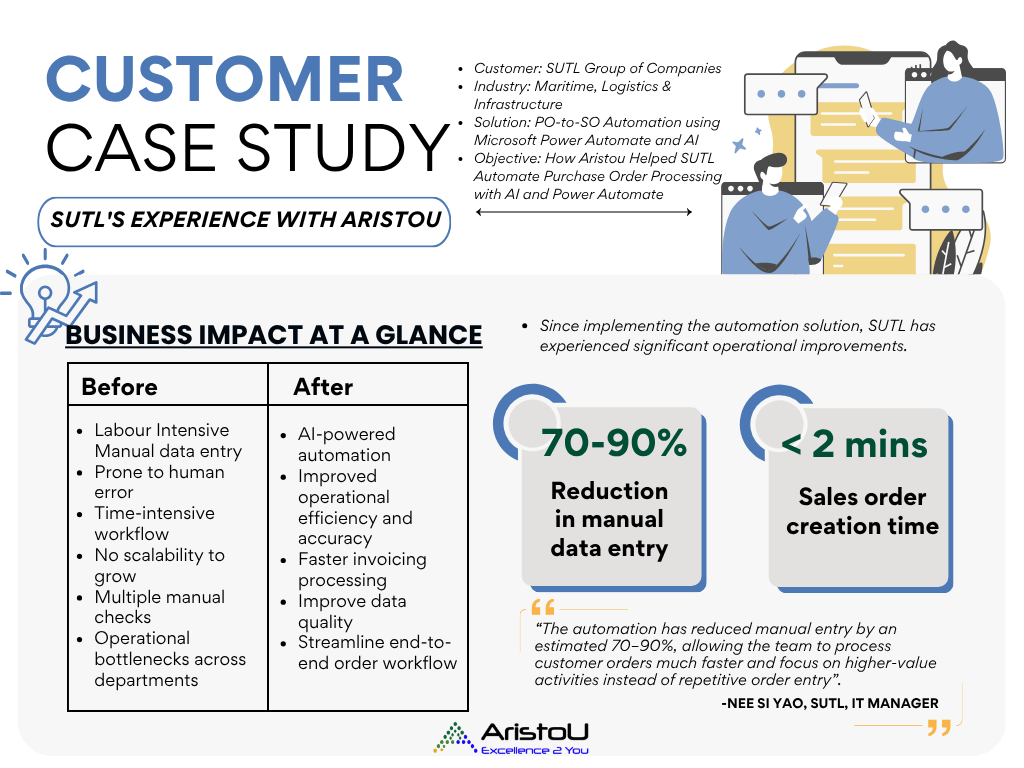
Processing customer purchase orders remains a manual, repetitive task that consumes valuable time and resources.
As businesses grow, increasing order volumes, varying document formats, and complex business requirements can quickly turn routine order processing into an operational bottleneck.
Seeking a more efficient and scalable approach, SUTL Group of Companies partnered with Aristou to automate its Purchase Order (PO) to Sales Order (SO) workflow using Microsoft Power Automate, AI-powered document processing, and Microsoft Dynamics 365 Business Central.
Today, validated purchase orders can be converted into sales orders in under 2 minutes, which would manually take over 20 minutes- a 90% reduction in processing time. This significantly reduces manual effort while improving accuracy, consistency and operational efficiency.
The Challenge
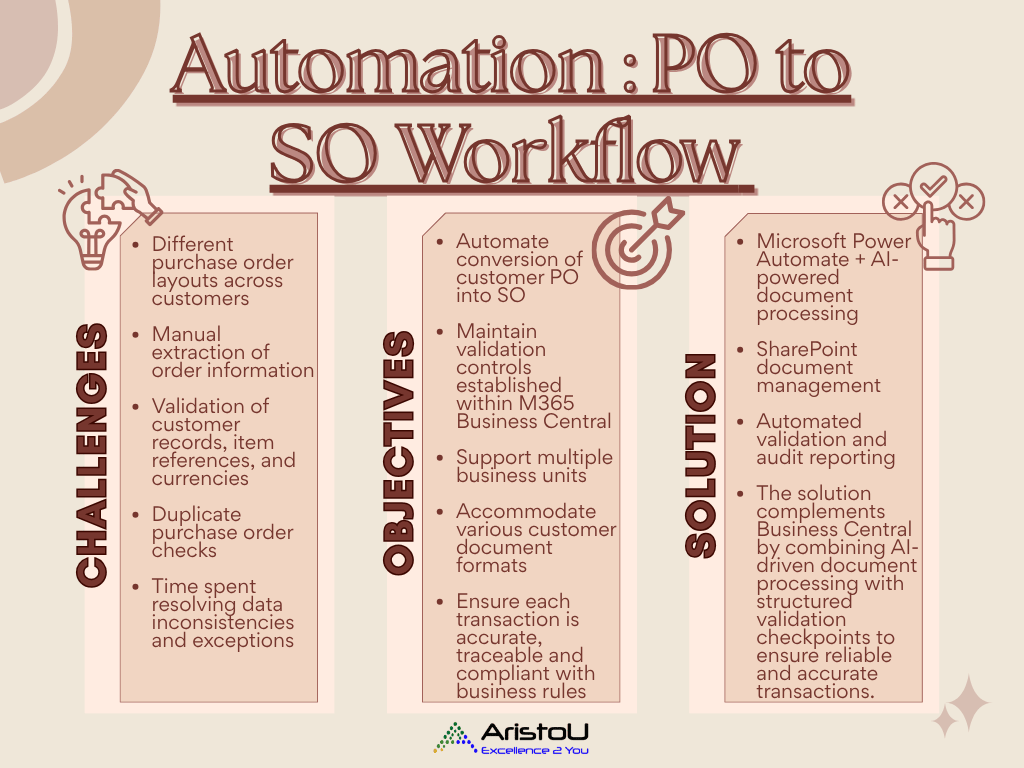
SUTL Group of Companies operates across multiple business units and serving a diverse customer base and also receives purchase orders in a wide range of formats. Each purchase order previously required manual review, validation, and entry into Microsoft Dynamics 365 Business Central before a sales order could be created.
The process was not only time-consuming but also introduced opportunities for human error and inconsistencies, particularly during periods of higher order volumes.
Some of the key challenges included:
-
Different purchase order layouts across customers
-
Manual extraction of order information
-
Validation of customer records, item references, and currencies
-
Duplicate purchase order checks
-
Time spent resolving data inconsistencies and exceptions
As order volumes increased, the manual process became increasingly difficult to scale while maintaining efficiency and service quality.
Objective:
SUTL Group of Companies’s objective was clear: Automate the conversion of customer purchase orders into sales orders while preserving the robust validation controls already established within Microsoft Dynamics 365 Business Central.
The solution needed to support multiple business units, accommodate various customer document formats, and ensure every transaction remained accurate, traceable, and compliant with existing business rules.
Aristou’s Solution
To address these challenges, Aristou designed and implemented an intelligent automation solution powered by Microsoft technologies, combining:
-
Microsoft Power Automate
-
AI-powered document processing
-
Microsoft Dynamics 365 Business Central integration
-
SharePoint document management
-
Automated validation and audit reporting
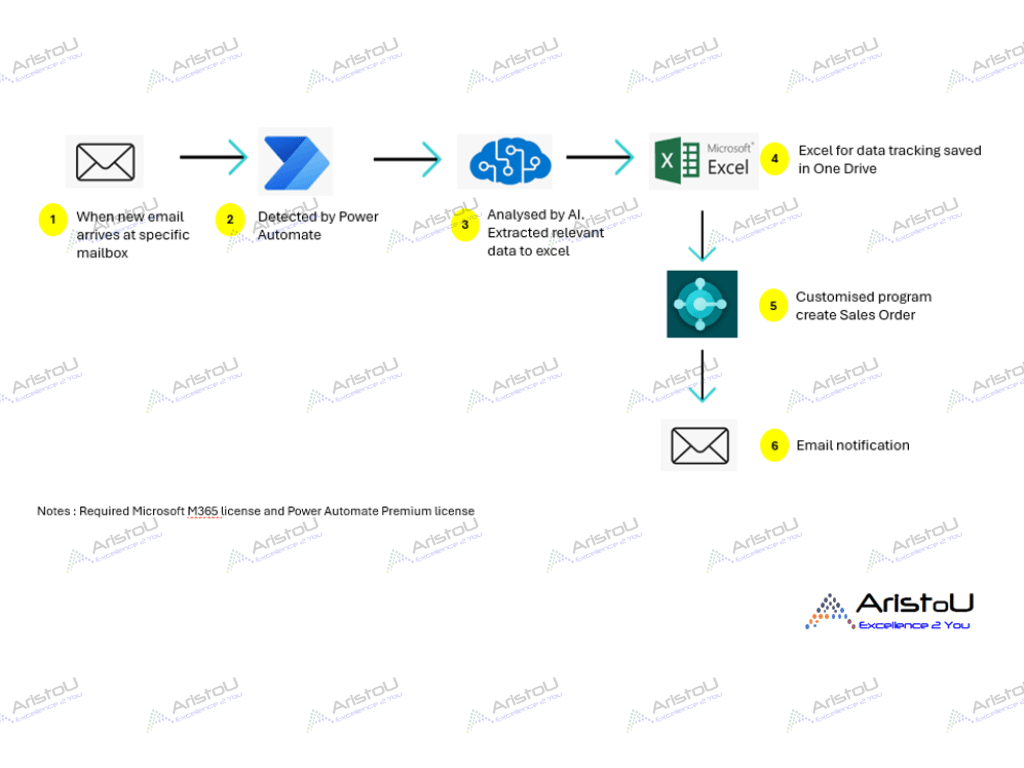
The automated workflow now performs the following processes:
-
Receives customer purchase orders.
-
Uses AI to extract relevant order information.
-
Validates customer, item, and currency information against Business Central.
-
Detects duplicate purchase orders.
-
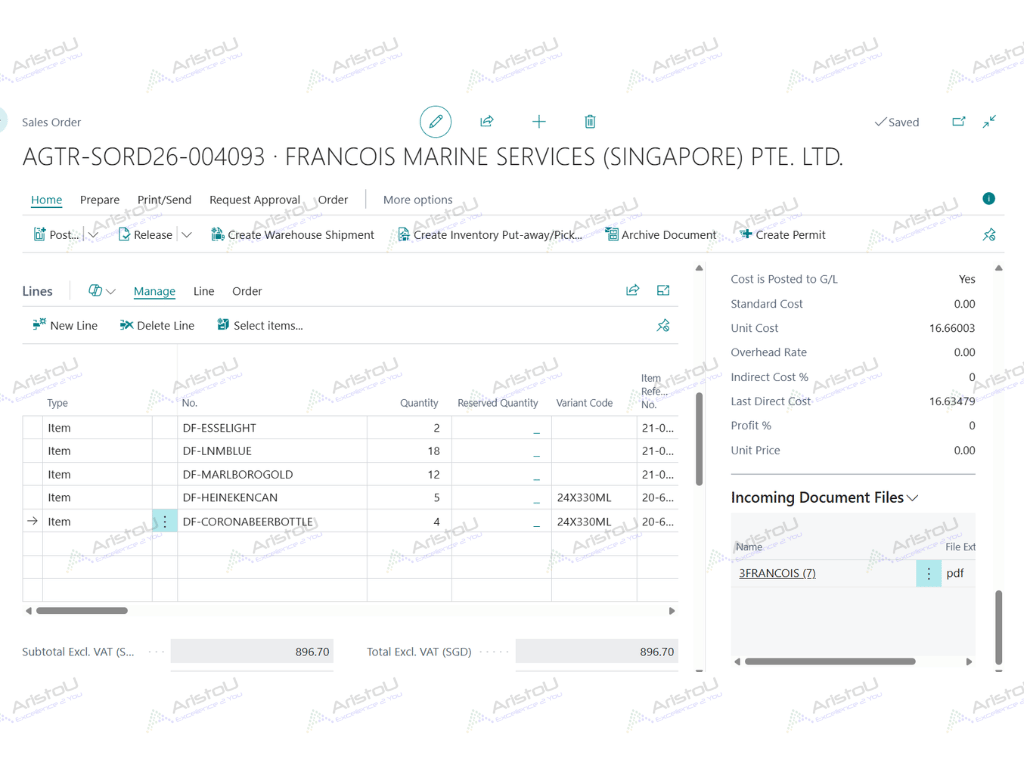
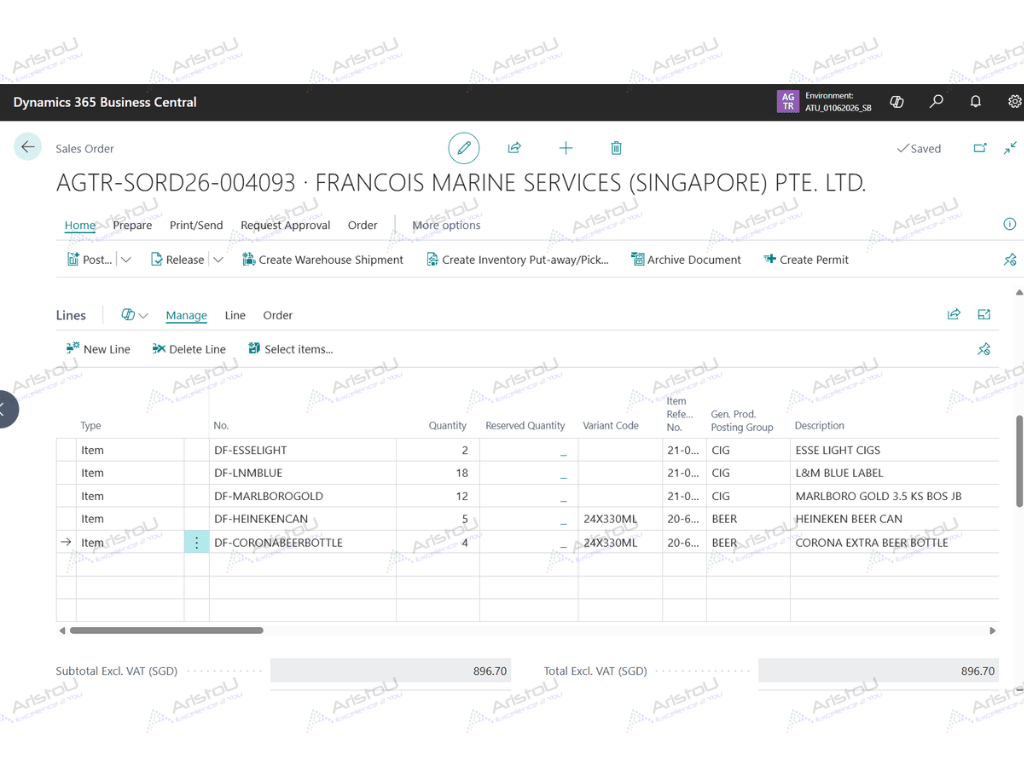
Automatically generates a Sales Order.
-
Records transaction details for audit and reporting purposes.
Rather than replacing existing ERP controls, the solution complements Business Central by combining AI-driven document processing with structured validation checkpoints to ensure reliable and accurate transactions.
Aristou’s Challenges: Navigating Real-World Complexity
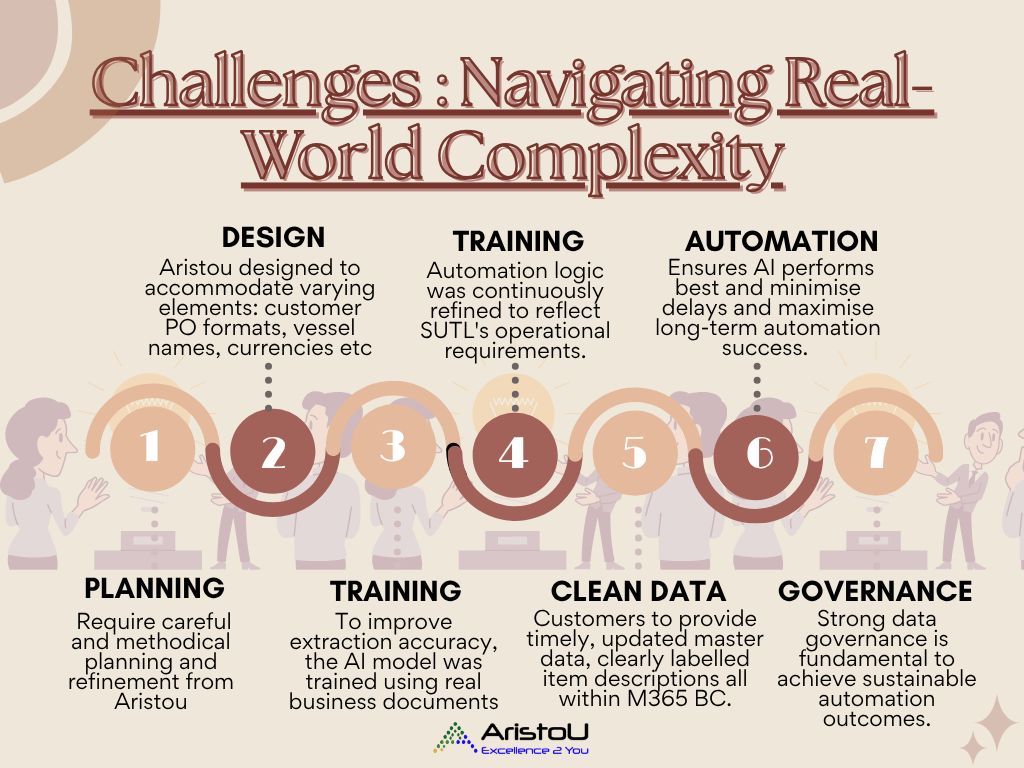
While automating a workflow may appear straightforward in theory, real-world business processes often introduce complexities that require careful planning and refinement from the Aristou team, led by Lim An Ni.
Throughout the project, the solution Aristou designed was to accommodate varying elements, such as:
-
Customer purchase order formats
-
Vessel name requirements
-
GST and non-GST products
-
Multiple currencies
-
Customer-specific item references
-
Documents with inconsistent layouts or varying image quality
To improve extraction accuracy, the AI model was continuously trained using real business documents while the automation logic was refined to reflect SUTL Group of Companies operational requirements.
The project also reinforced an important lesson for Aristou and any organisation embarking on automation: AI performs best when supported by clean, well-maintained master data and clearly defined validation rules.
An Ni required the assistance of the customers to provide timely, updated accurate master data, maintaining clearly labelled item descriptions, and ensuring data within Microsoft Dynamics 365 Business Central.
This ensures the AI model to perform at its full potential while helping to minimise implementation delays and maximise long-term automation success.
In addition, Anni emphasises that having strong data governance remains fundamental to achieving sustainable automation outcomes.
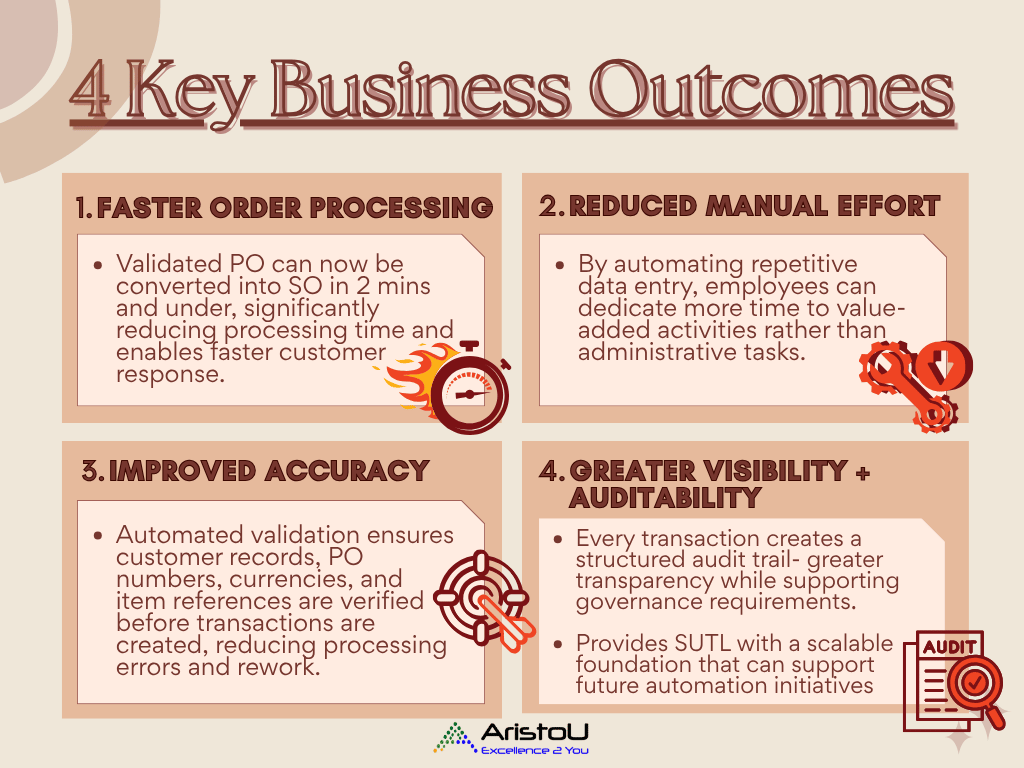
4 Key Business Outcomes
Following implementation, SUTL Group of Companies realised measurable improvements across its order management process.
-
Faster Order Processing
Validated purchase orders can now be converted into sales orders in under two minutes, significantly reducing processing time and enabling faster customer response.
-
Reduced Manual Effort
By automating repetitive data entry, employees can dedicate more time to value-added activities rather than administrative tasks.
-
Improved Accuracy
Automated validation ensures customer records, purchase order numbers, currencies, and item references are verified before transactions are created, reducing processing errors and rework.
-
Greater Visibility and Auditability




Leave a Reply