
Knowledge Mining with GenAI
Modern enterprises are generating more data than ever before; from customer transactions and sales orders to inventory movements and operational records. Yet for many organisations, the challenge is no longer collecting data, but turning it into meaningful action.
In today’s ERP-driven environments, vast volumes of customer, sales, and inventory data already exist within business systems. However, much of this information remains underutilised, locked within databases and reports rather than actively guiding business decisions.
At the same time, a new wave of technologies- Generative AI, intelligent agents, predictive demand forecasting, and automated inventory management are transforming how organisations work.
Tasks that once required weeks of manual analysis can increasingly be completed in hours, as AI systems analyse historical data, generate insights, and support decision-making in real time.
For consumer businesses and retail organisations in particular, this shift raises an important question: how should leaders redesign workflows, roles, and processes to take advantage of these capabilities?
This is where knowledge mining powered by Generative AI begins to play a critical role.
Let’s discuss this more below!
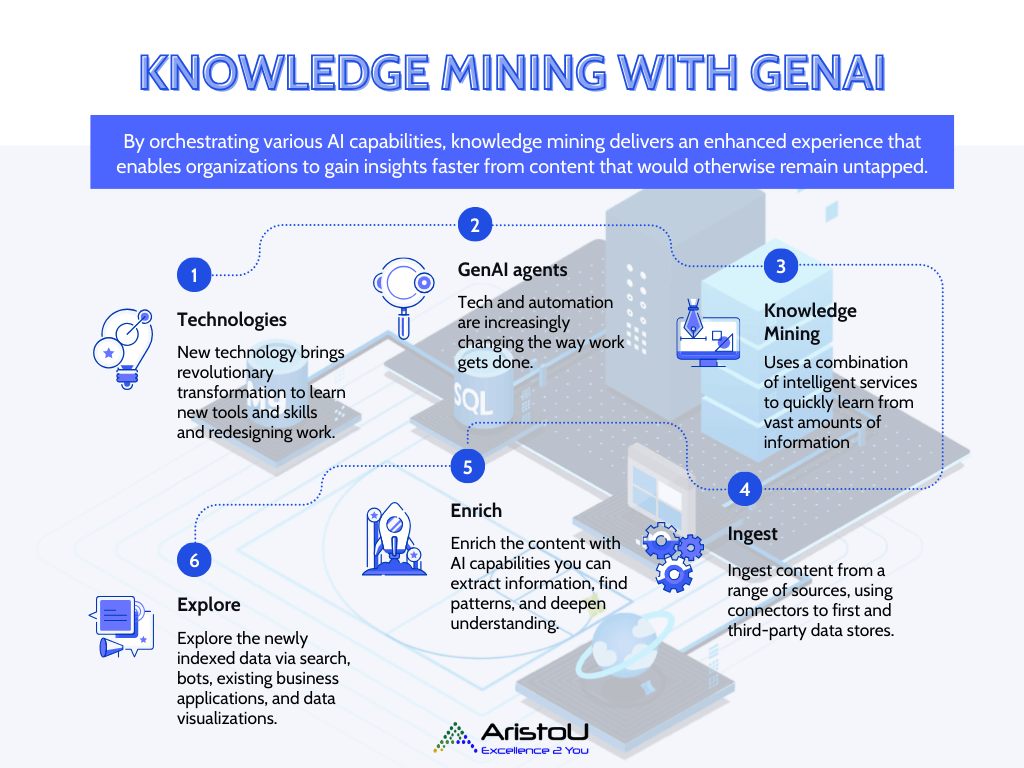
What Is Knowledge Mining in the Context of GenAI?
Knowledge Mining refers to the process of extracting insights, patterns, and actionable intelligence from both structured and unstructured enterprise data—and making those insights usable in real time by business users.
According to Microsoft (2026), knowledge mining is an emerging discipline in artificial intelligence that combines intelligent services to quickly derive value from vast volumes of information.
It enables organisations to explore data more deeply, uncover hidden insights, and identify relationships and patterns at scale; transforming raw information into business advantage.
With the rise of Generative AI (GenAI), knowledge mining is evolving beyond traditional dashboards and rule-based analytics. Instead of simply reporting what has happened, AI systems can now interpret data contextually and generate meaningful outputs for business users.
This evolution introduces new capabilities such as:
-
Semantic understanding of historical data
-
Context-aware recommendations
-
Automated content generation
-
Natural language interaction with enterprise systems
In this model, data no longer simply informs decisions- it helps drive them. AI systems can analyse enterprise data, generate insights, and translate those insights into practical outputs that support day-to-day business operations.
By orchestrating multiple AI capabilities together, knowledge mining enables organisations to unlock insights faster from content that would otherwise remain underutilised.
Businesses can analyse historical transactions, customer behaviour, and inventory availability, and transform this information into timely recommendations and ready-to-use communications.
However, adopting AI-driven knowledge mining is not simply about introducing new technology. It represents a broader shift in how organisations work. As collaboration between humans and intelligent systems becomes more integrated, successful transformation requires not only new tools but also new ways of designing workflows and decision-making processes.
Knowledge Mining in Action Nearly all enterprises say they see a clear need to automate the understanding of data from their unstructured information. Thirty percent are already automating the extraction of data from their unstructured information, and another 35% are investigating or piloting automation, according to the survey (HBR 2019).
At Aristou, our focus is on applying knowledge mining in practical, business-driven ways, helping organisations translate enterprise data into actionable insights that empower sales teams, enhance customer engagement, and unlock new operational efficiencies.
The following sections explore how knowledge mining with Generative AI is evolving, and how Aristou is translating this concept into real-world use cases.
Use Case 1: Intelligent Customer Re-Engagement Using GenAI
The Business Problem
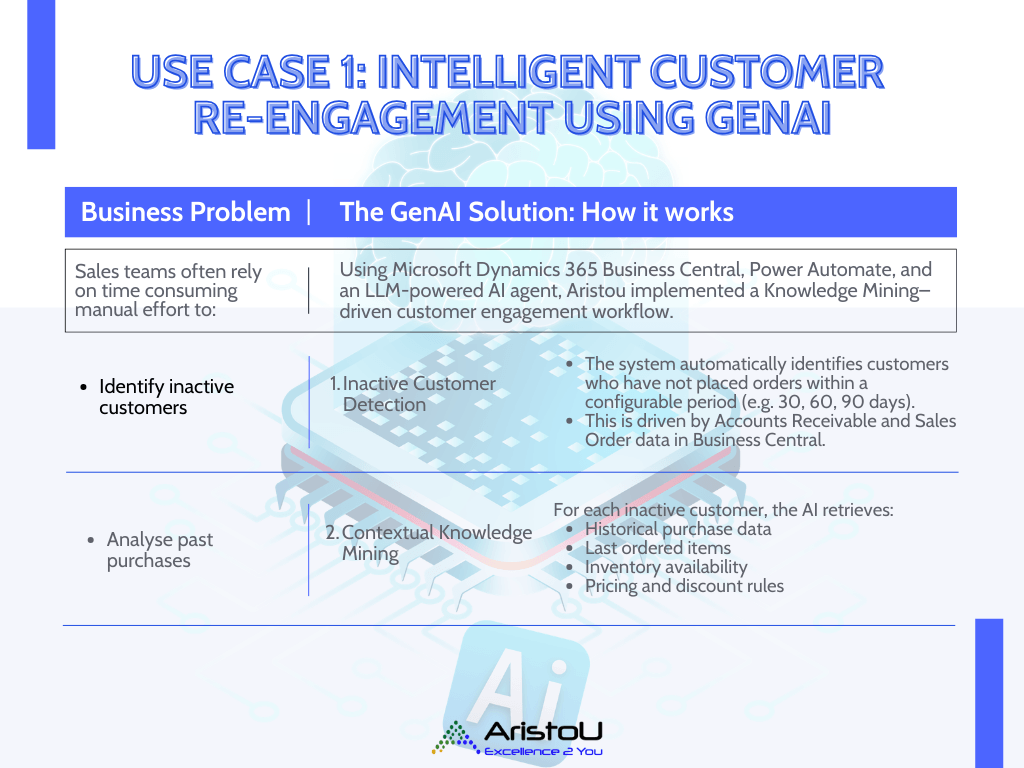
Sales teams often rely on manual effort to:
-
Identify inactive customers
-
Analyse past purchases
-
Decide what products to recommend
-
Craft outreach emails repeatedly
This process is time-consuming, inconsistent, and difficult to scale.
The GenAI Solution
Using Microsoft Dynamics 365 Business Central, Power Automate, and an LLM-powered AI agent, Aristou implemented a Knowledge Mining–driven customer engagement workflow.
How It Works:
-
Inactive Customer Detection
-
The system automatically identifies customers who have not placed orders within a configurable period (e.g. 30, 60, or 90 days).
-
This is driven by Accounts Receivable and Sales Order data in Business Central.
-
-
Contextual Knowledge Mining
-
For each inactive customer, the AI retrieves:
-
Historical purchase data
-
Last ordered items
-
Inventory availability
-
Pricing and discount rules
-
-
-
AI-Generated Product Recommendations
-
Using semantic reasoning (not hard-coded rules), the AI suggests:
-
Complimentary items
-
Discounted and non-discounted options
-
Recommendations grounded in real purchasing behaviour
-
-
-
Dynamic Email Content Generation
-
The AI automatically drafts personalised emails using varied wording each time.
-
Subject lines, tone, and structure are generated based on customer context.
-
No two emails are identical — reducing fatigue and increasing authenticity.
-
-
Automated or Assisted Execution
-
Sales users can review and send emails manually
-
Or trigger automated campaigns via job queues and schedules
-
The result: sales teams focus on relationships and strategy, not repetitive analysis and copywriting.
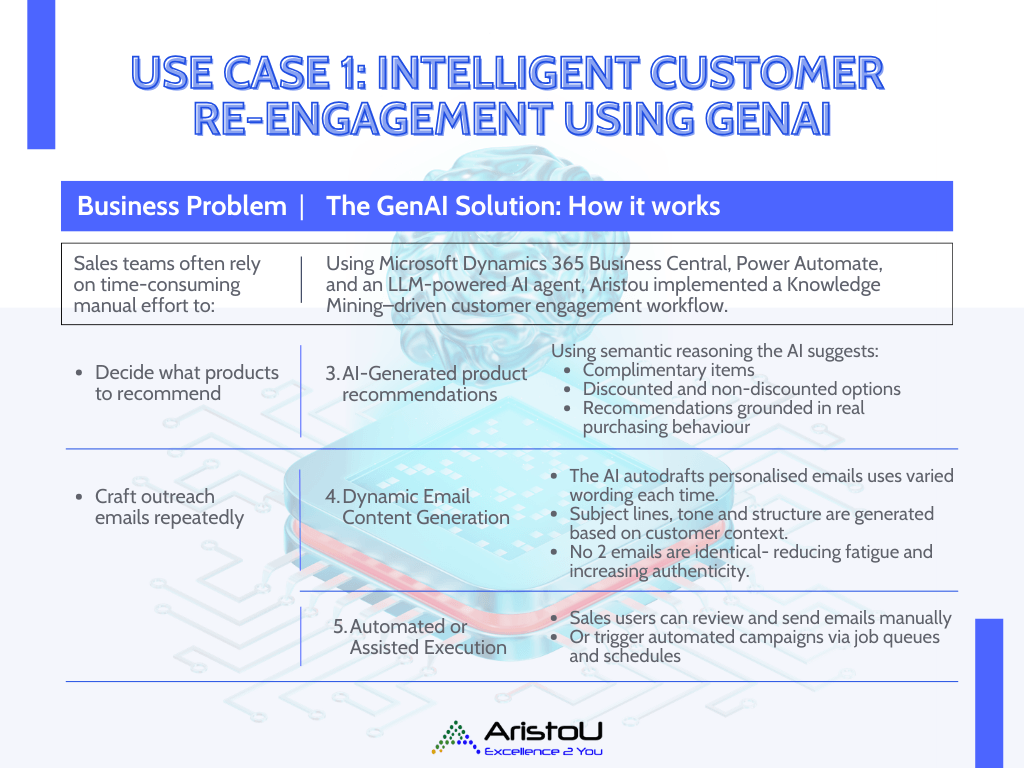
Extending Knowledge Mining to POS and Front-End Systems
One of the most powerful extensions of this approach lies in frontline systems.
Using the same AI reasoning:
-
POS systems can recommend complementary items at checkout
-
Suggestions are based on:
-
Current basket
-
Historical purchasing patterns
-
What similar customers bought
-
The same GenAI-driven logic used for email engagement can also be applied at the point of sale.
At checkout, the system can recommend additional items based on what customers currently have in their basket, drawing from patterns where other customers purchased similar combinations.
This allows businesses to surface relevant suggestions in real time without relying on static rules or manual configuration, mirroring the intelligence seen in consumer platforms yet grounded in your own enterprise data.








Leave a Reply