
Microsoft’s Generative AI Ecosystem: From Productivity to Intelligent Business Operations
Generative AI seems to be the buzz word of 2026- it has moved rapidly from an emerging technology to a practical business capability.
From drafting content and summarising information to analysing data and automating workflows, SMEs are increasingly exploring how AI can help employees work faster and make better decisions- beyond using an AI chatbot in isolation.
Organizations already operating within the Microsoft ecosystem or considering a move to Microsoft have good news: Generative AI becomes significantly more powerful when it is connected to the tools, data and processes employees already use every day.
For SMEs, this creates an important opportunity: moving from AI that simply generates information to AI that understands business context and helps turn information into action.

Photo credits: Generative AI (2026)
AI vs Generative AI vs Agentic AI
Before exploring Microsoft’s ecosystem, it is useful to distinguish between three related concepts.
While traditional AI was designed to recognize patterns and make predictions, generative AI creates new content such as text, images, video, audio and software code. Agentic AI focuses on achieving goals by planning, making decisions and carrying out multi-step workflows with varying levels of autonomy. 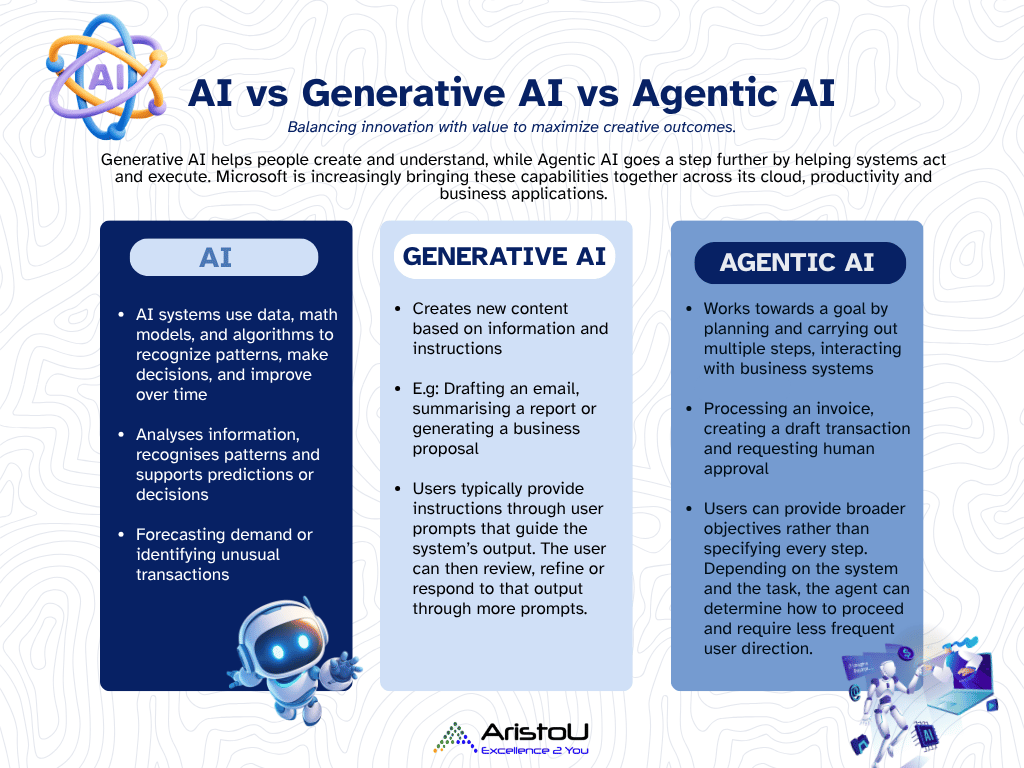
Simply put- Generative AI helps people create and understand, while Agentic AI goes a step further by helping systems act and execute.
In fact, Microsoft is increasingly bringing these capabilities together across its cloud, productivity and business applications.
The Microsoft Generative AI Ecosystem
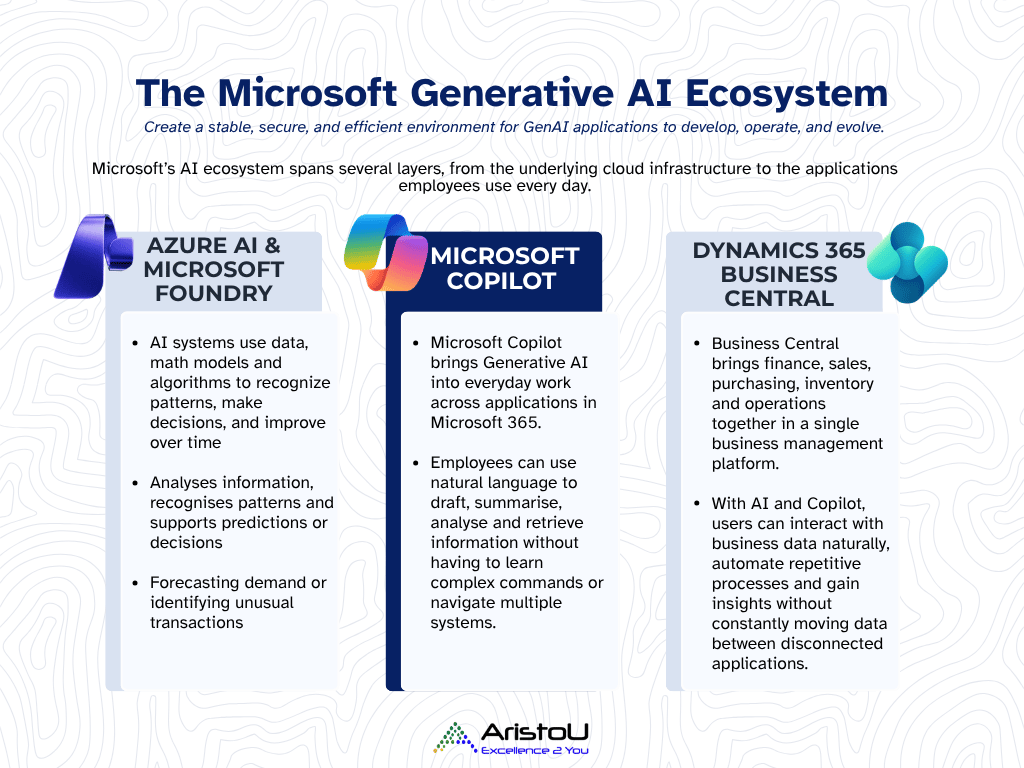
Microsoft’s AI ecosystem spans several layers, from the underlying cloud infrastructure to the applications employees use every day.
1. Azure AI and Microsoft Foundry
At the foundation is Microsoft Azure, which provides cloud-based AI services for organisations that want to develop, deploy and manage AI solutions.
Azure AI services and Microsoft Foundry provide the infrastructure and tools needed to build AI-powered applications and agents, while Azure AI Search can help organisations retrieve and ground information from their own data.
For businesses, this means AI does not have to operate as a disconnected tool. It can be designed around enterprise data, security requirements and specific business processes.
2. Microsoft Copilot
At the user level, Microsoft Copilot brings Generative AI into everyday work across applications such as Microsoft 365. Employees can use natural language to draft, summarise, analyse and retrieve information without having to learn complex commands or navigate multiple systems.
This is where many organisations first experience the value of Generative AI, but productivity assistance is only the beginning.
3. Dynamics 365 Business Central
For SMEs, the real transformation happens when AI reaches the ERP. Microsoft Dynamics 365 Business Central brings finance, sales, purchasing, inventory and operations together in a single business management platform.
With AI and Copilot capabilities increasingly embedded into Business Central, users can interact with business information more naturally, automate repetitive processes and gain insights without constantly moving data between disconnected applications.
Microsoft describes its Business Central AI capabilities as helping eliminate tedious tasks, connect AI to business workflows and make the system easier to use.
This creates a shift from: ERP as a system of record -> ERP as an intelligent business platform.
What Can Generative AI Actually Create?
Generative AI can create many types of content across many different domains. For starters, it is capable of producing:
-
Text
Emails, reports, summaries, proposals, documentation and marketing content. -
Images and video
Visual concepts, marketing assets, product imagery and video content. -
Speech and audio
Synthetic voice, transcription and conversational experiences. -
Software code
Code suggestions, documentation, translations between programming languages and development assistance. -
Insights and recommendations
AI can analyse large volumes of information and turn patterns into summaries, recommendations or potential next steps.
The overarching benefit of Generative AI is greater efficiency. Precisely due to its ability to generate content and answers on demand, Gen AI has the potential to accelerate or automate labour-intensive tasks, cut costs, and free employees time for higher-value work.
For businesses, the most valuable question pivots from asking what AI can generate, to how AI can best assist the business needs. That is where enterprise data becomes critical.
From Generative AI to Knowledge Mining
Most organisations already possess enormous amounts of valuable information- customer transactions, sales orders, inventory, supplier records, financial data etc, just to name a few.
The challenge is often not a lack of data, but the difficulty of finding, understanding and acting on it. This is where knowledge mining becomes interesting.
As we explored in our previous article, Knowledge Mining with GenAI is about extracting insights and relationships from structured and unstructured enterprise data and turning them into information that people can actually use.
Instead of simply asking: “What happened?” SMEs can begin asking: “What does this mean?” and “What should we do next?”
Aristou’s 6 Step Approach: Turning Business Data into Action
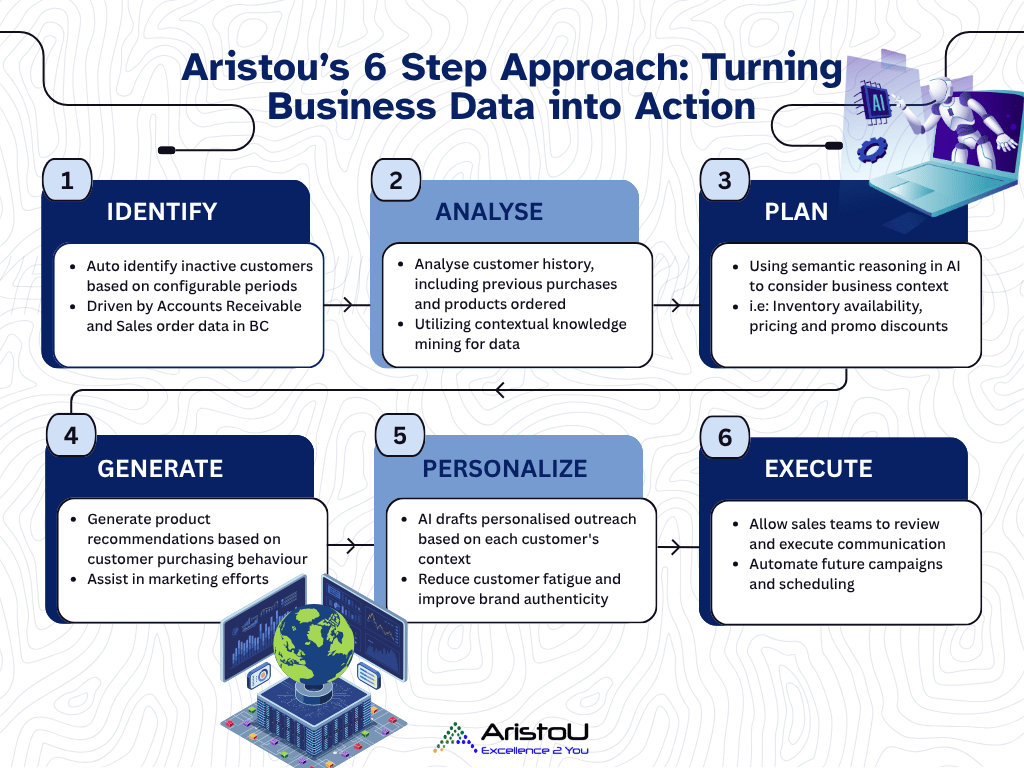
At Aristou, we’ve been exploring what knowledge mining can look like when it is connected directly to an organisation’s operational systems.
One example combines Microsoft Dynamics 365 Business Central; Power Automate and an LLM-powered AI agent to create an intelligent customer re-engagement workflow.
Instead of manually identifying inactive customers, review historical purchases, determine relevant products and write individual follow-up emails, the workflow can:
-
Identify inactive customers based on configurable periods.
-
Analyse customer history, including previous purchases and products ordered.
-
Consider business context, such as inventory availability, pricing and discount rules.
-
Generate product recommendations based on purchasing behaviour.
-
Draft personalised outreach based on each customer’s context.
-
Allow sales teams to review and execute the communication or automate the process where appropriate.
The ability to combine business context, data and workflow automation to help determine what the email should be about in the first place is the difference between using Generative AI as a writing assistant and using it as part of an intelligent business process.
What Does This Mean for Business Central Users?
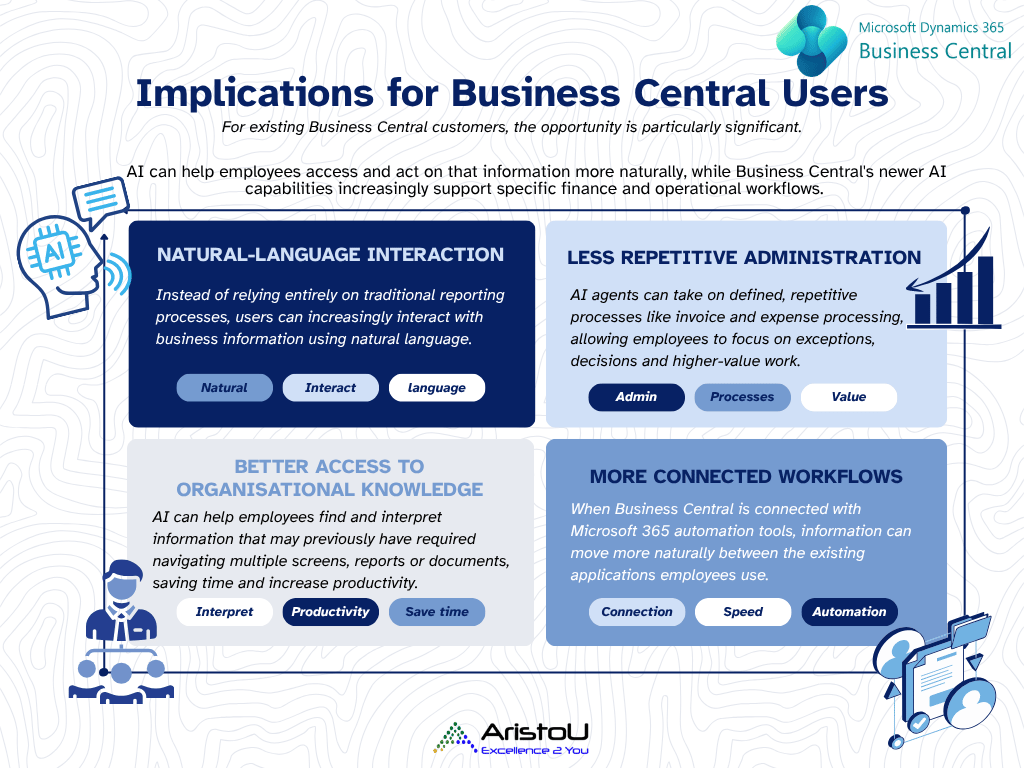
For existing Business Central customers, the opportunity is particularly significant.
Your ERP already contains valuable operational knowledge. AI can help employees access and act on that information more naturally, while Business Central’s newer AI capabilities increasingly support specific finance and operational workflows.
E.g: Microsoft’s current Business Central capabilities include AI-powered agents for areas such as payables, sales orders and expenses. These agents can perform defined tasks with human review and intervention where required.
-
Natural-language interaction
Instead of relying entirely on traditional reporting processes, users can increasingly interact with business information using natural language.
-
Less repetitive administration
AI agents can take on defined, repetitive processes such as invoice and expense processing, allowing employees to focus on exceptions, decisions and higher-value work.
-
Better access to organisational knowledge
AI can help employees find and interpret information that may previously have required navigating multiple screens, reports or documents.
-
More connected workflows











Leave a Reply